Juqu Display Font for Handmade Creators
If you’ve ever spent twenty minutes tweaking a label just to get the right “spark” — that joyful, unmistakable energy customers notice before they even read the words — then Juqu is the display font you’ve been waiting for. As someone who designs printable wall art, hand-pours soy candles, and ships custom wedding stationery every week, I don’t reach for fonts lightly. Juqu stands out because it balances bold personality with real-world usability — no small feat in a display font.
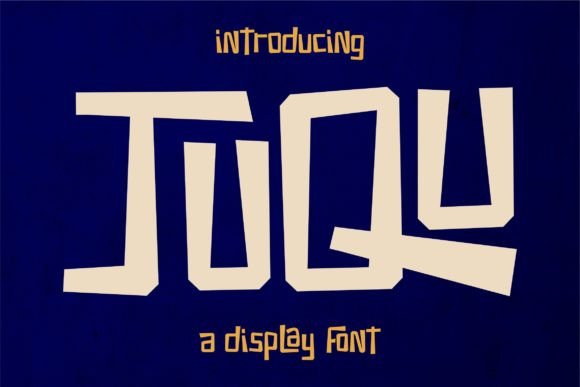
Juqu’s charm lives in its playful, unconventional letterforms: slightly uneven baselines, gentle curves with confident angles, and open counters that keep everything airy and legible. It’s whimsical without being childish, quirky without sacrificing polish. That clean line work you’ll notice? It’s intentional — built for crisp cutting on Cricut and Silhouette machines, smooth printing on kraft tags or glossy sticker sheets, and sharp rendering in digital mockups. Unlike some display fonts that blur at 12pt or collapse when scaled down, Juqu holds its own from 8mm product tags to 24-inch farmhouse signs.
Here’s where Juqu shines in everyday craft production:
- Candle & soap labels: Use Juqu for brand names (“Hearth & Honey”) or scent titles (“Lavender Rain”) — its friendly weight reads clearly on matte paper and pairs beautifully with minimalist icons or botanical line art.
- Stickers & planner inserts: Its generous x-height and spaced lettering prevent ink bleed on thin sticker stock. Try “YES!” or “You Got This!” in Juqu as motivational accents on weekly planner pages or bullet journal kits.
- Wedding stationery: Welcome signs, menu cards, and foil-stamped place cards gain warmth and approachability with Juqu — especially when paired with a refined serif like Playfair Display for body text.
- Digital printables: From holiday SVG bundles to editable Canva templates, Juqu adds instant visual distinction. Customers scrolling Etsy listings pause longer on thumbnails where Juqu anchors the headline — it signals “handcrafted,” not generic.
- Product packaging & boutique tags: Small-batch skincare brands use Juqu for batch numbers or ingredient highlights (“Cold-Pressed • Small-Batch • Vegan”). Its clean lines ensure scannability, even when laser-etched onto wooden tags.
Juqu isn’t designed for paragraphs — and that’s by design. It’s a display font, meant for impact: headlines, logos, short phrases, and decorative emphasis. Think “Grand Opening,” “Hand-Poured in Portland,” or “Est. 2021” — not ingredient lists or care instructions. For those, pair Juqu thoughtfully: try it with a neutral sans serif (like Montserrat or Inter) for contrast and balance, or layer it over a soft handwritten script for invitation suites. Avoid pairing with other high-contrast display fonts — Juqu carries enough presence on its own.
When prepping files for production, keep readability front of mind. For vinyl cutters or die-cut machines, avoid using Juqu below 14pt on physical stickers under 1.5 inches wide — the subtle joins between letters need breathing room. On printed cards, test a proof at actual size: Juqu’s open shapes hold up well on uncoated cardstock, but ultra-thin strokes may soften on low-DPI home printers. If your version includes stylistic alternates or swashes (check your download folder!), reserve those for hero graphics — not mass-produced labels where consistency matters more than flourish.
Juqu comes in standard OpenType (.otf) and TrueType (.ttf) formats — compatible with Adobe Creative Suite, Cricut Design Space, Silhouette Studio, Canva, and Affinity apps. No extra plugins needed. While the base character set covers English, numerals, and common punctuation, verify multilingual support if you serve bilingual markets — some display fonts skip extended Latin or accented characters.
Licensing is non-negotiable for sellers — and Juqu’s commercial license covers exactly what handmade creators need. You’re cleared to use it on physical products you sell (mugs, tote bags, greeting cards), digital downloads (PDF planners, SVG cut files, Canva templates), client projects (logo concepts, shop signage), and social media graphics promoting your shop. Just remember: you can’t resell Juqu itself as a standalone font file, embed it in web fonts for public use, or claim it as your own design asset. That clarity saves headaches later — especially when scaling from Etsy side-hustle to full-time studio.
I first used Juqu on a series of seasonal market banners — “Pumpkin Spice & Everything Nice” in warm terracotta ink on raw canvas. Shoppers stopped mid-aisle. Not just to read it — but to smile, snap photos, and ask where the sign was made. That’s Juqu’s quiet power: it doesn’t shout. It invites. It feels human, intentional, and unmistakably *yours* — whether you’re hand-lettering a chalkboard menu or automating 500 holiday gift tags.
For anyone building a brand rooted in authenticity — not trends — Juqu offers something rare among display fonts: expressive character without sacrificing craftsmanship. It’s the kind of typeface that makes customers feel seen before they even hold your product. And in a world of algorithm-driven feeds and crowded marketplaces, that emotional resonance isn’t just nice to have. It’s how your handmade goods stand out, stay remembered, and earn repeat buyers.